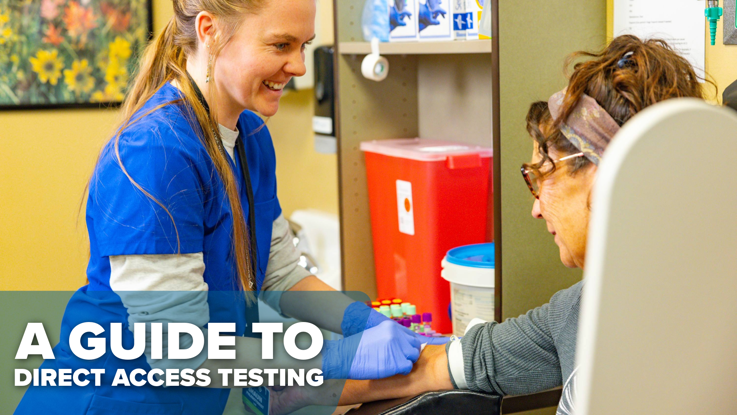
Convenient access to year-round low-cost laboratory testing.
Direct Access Testing is laboratory testing in which individuals have the
option to choose selected tests without a clinical provider’s order.
Direct Access Testing is an important resource but shouldn’t be
considered a substitution for treatment by a medical provider. You should
discuss test results with their primary care provider.
Direct Access Testing is available on a walk-in basis, no appointment necessary,
7 days a week from 7:30 a.m. to 6 p.m.
Payment and Registration
Direct Access Testing services are offered as a self-pay option and require
payment in full at the time of service.
Patients who choose Direct Access Testing acknowledge that services are
being obtained outside of the standard insurance billing process. No claim
will be submitted on the patient's behalf, no additional billing will
occur, and payments are non-refundable.
ABO Rh Blood Typing: Detects ABO type and Rh type of a person's blood. Example: "B positive"
blood type versus "O negative" blood type, etc.
Complete Blood Count w/ Auto Differential(CBC): This screening measures the total number of white blood cells, red blood
cells (with hematocrit and hemoglobin levels), and platelets.
Comprehensive Metabolic Panel (CMP): This is a blood test that gives important information about your body's
chemical balance and metabolism. It provides a broad picture of your health
by measuring different substances in your blood. The CMP is often used
as a routine checkup to help your doctor assess the health of your kidneys,
liver, and other vital organs, as well as to detect issues with blood
sugar levels, electrolyte balance, and protein levels.
C-Reactive Protein (CRP): This test is used to find inflammation in your body. Inflammation could
be caused by different types of conditions, such as an infection or autoimmune
disorders like rheumatoid arthritis or inflammatory bowel disease. This
test measures the amount of CRP in your blood. CRP is a protein made by
the liver and sent into the bloodstream. Blood levels may be higher when
you have inflammation or an infection. Because CRP levels often go up
before you have symptoms of pain or fever and drop down as you recover,
the CRP test is especially useful for tracking infections.
Estradiol: Estradiol is the main form of estrogen in the blood. The test is used
to evaluate reproductive and hormonal health in both women and men. It
can help investigate menstrual problems, infertility, or symptoms related
to menopause. It may also be used to assess early or delayed puberty,
monitor hormone therapy, or help detect hormone-producing tumors such
as ovarian tumors or testicular tumors.
Ferritin (Serum Ferritin): Ferritin is an iron-containing protein, the primary iron form stored
inside cells. The small quantity of ferritin that is released into the
bloodstream reflects the amount of total iron stored in the body. However,
ferritin is an acute-phase reactant in the blood, which means that circulating
ferritin levels increase with infection and inflammation, Therefore, circulating
ferritin levels must be interpreted by your doctor together with other
laboratory values (such as Serum Iron and other lab values).
Folate (Folic Acid): Folate is one of the B vitamins the body uses for growth and development
and the production of red blood cells, white blood cells and platelets.
A Folate Test can help determine the cause for anemia or aid in the diagnosis
of malnutrition or malabsorption. This test is typically ordered when
someone has symptoms of anemia or vitamin deficiency. It may also be ordered
as a follow-up to irregular results from a CBC test or to monitor someone
who is being treated for folate deficiency.
Follicle-Stimulating Hormone (FSH): This test measures the level of follicle-stimulating hormone (FSH). FSH
is an important hormone made in your pituitary gland. FSH travels to the
testicles to tell the cells in the testicles to make sperm. FSH travels
to the ovaries to stimulate the growth of eggs during the menstrual cycle.
FSH is also important for sexual development in children.
Free Thyroxine (Free T4, FT4): Free Thyroxine (FT4) is measured with Thyroid-Stimulating Hormone (TSH)
when thyroid disorders are suspected. Elevations in FT4 can indicate hyperthyroidism
(overactive thyroid); decreases can indicate hypothyroidism (underactive
thyroid). This test is used to find out how well your thyroid gland is working.
Free Triiodothyronine (free T3, FT3): Free T3 is used to assess thyroid function and may be ordered to help
monitor a known thyroid disorder. Elevated levels of FT3 may indicate
hyperthyroidism (overactive thyroid).
Hemoglobin A1C (HgbA1c, HbA1c): This test screens for diabetes by measuring your average blood sugar
control for the past 2 to 3 months. For people with known diabetes, it
indicates how well your diabetes treatment plan is working.
Hepatitis C Ab: This is a panel of blood tests that looks to see whether you have a hepatitis
virus infection. The tests may be known by different names. This depends
on your doctor and lab. The tests look for antibodies that your body has
made against a hepatitis virus. They also look for parts of a specific
virus (antigens).
Iron (Serum Iron): This test is used to monitor the amount of iron (serum iron) circulating
in the bloodstream. Iron is an essential mineral and a vital component
of hemoglobin, the substance in red blood cells that carries oxygen from
your lungs and transports it throughout your body. The Serum Iron test
can be ordered with the Serum Ferritin test to monitor for iron deficiency
(anemia) or iron-overload diseases.
TIBC (Total Iron Binding Capacity) (cannot be ordered by itself): This is a blood test to see if you have too much or too little iron in
your blood. Iron moves through the blood attached to a protein called
transferrin, produced in the liver. TIBC measures the blood's capacity
to bind iron with transferrin and helps your provider know how well the
protein transferrin is carrying iron in your blood.
Taken together with Iron and Transferrin Saturation, clinicians usually
perform a TIBC test when concerned about iron-deficiency anemia. Since
the liver produces transferrin, alterations in liver function (such as
cirrhosis, hepatitis, or liver failure} must also be considered when performing
this test.
Transferrin Saturation (% Saturation or % Saturation of Transferrin with Iron): The optimal range is 25 - 35%. When it is less than 17%, iron-deficiency
anemia is possible. When it is greater than 45%, iron overload is possible.
In either case, further testing might be necessary.
Iron & TIBC: This blood panel includes Iron, Serum Iron, Total Iron Binding Capacity
(TIBC) and Transferrin Saturation (also known as % Saturation or % Saturation
of Transferrin with Iron).
Lipid Panel: The Lipid Panel screens for blood findings associated with cardiovascular
risk. It tests for total cholesterol, triglycerides, and HDL (High Density
Lipoprotein) cholesterol. Studies have shown important cardiac risk factors
include age, smoking status, hypertension (high blood pressure), diabetes,
blood total cholesterol levels and blood HDL cholesterol levels. Fasting
for 10-12 hours prior to the blood draw is preferred, but not required.
However, people with diabetes should not fast. Check with your medical
provider for specific recommendations. Drink water and continue to take
prescription medications.
Lipoprotein (a): This test measures the level of lipoprotein (a), a cholesterol-carrying
particle that is largely determined by genetics. Elevated levels may increase
the risk of heart disease and other cardiovascular conditions.
LDL (low density lipoprotein): This test measures the amount of low-density lipoprotein-cholesterol
(LDL-C) in your blood. LDL cholesterol is often called "bad"
cholesterol because it causes plaque to build up inside your arteries
and leads to heart disease.
Magnesium: This test evaluates the level of magnesium in your blood to help determine
the cause of abnormal levels of magnesium, calcium and/or potassium. Magnesium
is vital for energy production, muscle contraction, nerve function and
the maintenance of strong bones. It also regulates blood pressure, helps
the heart to function normally, controls blood sugar level and supports
the immune system.
Pregnancy, Serum Test (Qualitative hCG blood test): This test detects the presence of human chorionic gonadotropin (hCG)
in your blood, a hormone produced during pregnancy. Results are reported
as either positive or negative. The hormone is detectable as early as
7-10 days after conception. Results are reported as either positive or
negative. However, a "false negative" can occur if the test
is performed too early in pregnancy.
Pregnancy, Urine Test (Qualitative hCG urine test):
This test detects the presence of human chorionic gonadotropin (hCG) in
your urine, a hormone produced during pregnancy. The hormone is detectable
as early as 7-10 days after conception. Results are reported as either
positive or negative. Urine testing tends to have a higher likelihood
of “false negatives”, especially if the urine is diluted.
This can occur if you're over-hydrated, which may cause the hCG concentration
to fall below the detection threshold. For the most accurate result, it
is recommended to use first-morning urine, which has the highest concentration of hCG.
Progesterone: Measures the level of Progesterone. Your ovaries make progesterone after
ovulation. The most important role of progesterone is to get your uterus
ready so that it can receive, implant, and support a fertilized egg during
pregnancy.
Prostate-Specific Antigen Screening (PSA): This screening measures the level of prostate-specific antigen (PSA) in
the blood. PSA is a protein produced by the prostate gland. PSA testing
can help assess prostate health and may be used to screen for or monitor
prostate conditions, including prostate cancer.
Testosterone, Free: This test measures the amount of unattached, or "free," testosterone
in your blood. Most of the testosterone in your blood attaches to two
proteins: albumin and sex hormone binding globulin. Some testosterone
is free, which means that it isn't attached to proteins. Free testosterone
and albumin-bound testosterone are also referred to as bioavailable testosterone.
This is the testosterone that is easily used by your body.
Testosterone, Total: This test measures the level of the hormone testosterone in your blood.
Testosterone is a male sex hormone (androgen) that helps male features
develop. Testosterone is made in the testes in males, the ovaries in females,
and in the adrenal glands.
Thyroid Stimulating Hormone (TSH): This test is a screening for thyroid function, and to detect mild and
overt hypothyroidism (underactive thyroid) or hyperthyroidism (overactive
thyroid). This test can help monitor therapy with thyroid hormone/Synthroid/Levothyroxine
medication. TSH results can be used with Free Thyroxine (Free T4) levels
to detect thyroid dysfunction.
Uric Acid: This blood test measures the amount of uric acid in your blood. High levels
of uric acid can increase the risk of gout and may be associated with
certain kidney conditions. The test may be used to help evaluate these
conditions or monitor treatment.
Urinalysis w/o Microscopic (UA): A urine sample is required. Urinalysis provides an overview of the function
of the kidneys. The kidneys play a key role in the excretion of by-products
of cellular metabolism and regulation water, acid-base and electrolyte
balance. A urinalysis screens for protein or red blood cells in the urine
(kidney disease/kidney function) and bacteria and white blood cells in
the urine (urinary tract infection/bladder infection).
Vitamin B12: An essential vitamin which is necessary for the formation of healthy
red blood cells and proper nerve function. A deficiency in B12 can cause
a condition known as Macrocytic Anemia in which red blood cells are larger
than normal. Common causes for Vitamin B12 deficiency are malnutrition,
liver disease, alcoholism, and malabsorption disorders such as Celiac
Disease, Cystic Fibrosis, and Inflammatory Bowel Disease. A Vitamin B12
test may be ordered when a person is experiencing symptoms such as diarrhea,
dizziness, fatigue, pale skin, loss of appetite, rapid heartbeat, shortness
of breath, tingling or numbness in the extremities and a sore mouth or tongue.
Vitamin D (25-Hydroxy Vitamin D): This screening can provide an initial baseline level of Vitamin D before
starting Vitamin D therapy, or to monitor Vitamin D levels if you take
a Vitamin D supplement. Vitamin D deficiency is a worldwide problem. Your
body requires Vitamin D to absorb calcium, and Vitamin D plays a vital
role in protecting your bone health (preventing and treating osteoporosis).