Staff Spotlight: Alyssa Rodriguez Journey to the Leadville 100
- Category: Rehabilitation
- Posted On:
GVH rehabilitation specialist, Alyssa Rodriguez is chasing the finish line she has been working toward for six years. And she is bringing every lesson from the trail into her clinic.
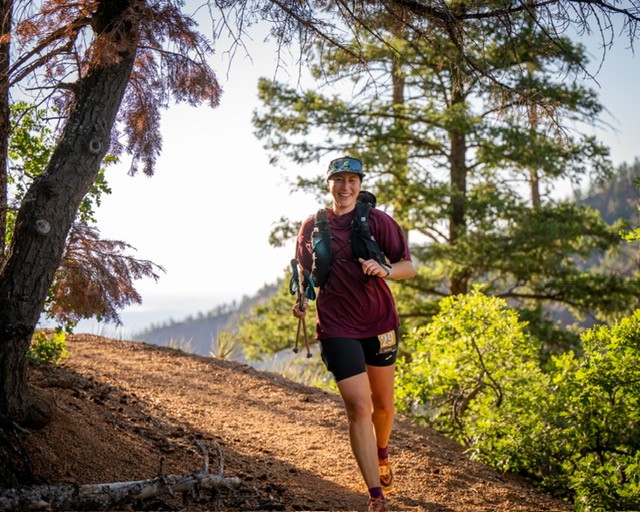 On August 22, Alyssa Rodriguez will stand at the starting line of the Leadville 100, one of the most demanding ultramarathons in the world. The race covers 100 miles through the Colorado Rockies, climbing above 12,000 feet, and demands everything from the athletes who attempt it.
By day, Alyssa is a physical therapist at GVH’s Rehabilitation Department in Gunnison, where she works with sports and orthopedic patients ranging from high school athletes to older adults determined to stay active and independent. By her own hours, she is logging five to six runs a week, heavy strength sessions, power-hiking training, and back-to-back long runs designed to teach her body to keep moving on exhausted legs.
The two sides of her life are not as separate as they might seem.
From Houston to the High Country
Alyssa grew up in Houston, Texas, surrounded by sports. Her father was a football coach, and she played softball, basketball, and volleyball growing up. Managing injuries was simply part of the game. When her mother first suggested physical therapy as a career, Alyssa brushed it off.
Then she spent time observing in a PT clinic in college. That was all it took.
In February 2025, Alyssa and her husband JJ traded Houston for the Gunnison Valley, drawn by the mountains, the pace, and the kind of close-knit community that is hard to find in a city. What she found at GVH matched what she was looking for.
“One of the things I enjoy most about working at this hospital is serving such an active community,” she says. “From middle and high school athletes to older adults who want to remain active and independent. This valley is a perfect fit for what I love to do.”
A Promise Made
Alyssa’s connection to the Leadville 100 began with a documentary and a lottery. In 2020, she and JJ were both selected to race through the lottery system, a rare outcome in itself. Her grandfather, who was seriously ill at the time, became one of her biggest sources of inspiration. He was also one of the few people in her life who never once suggested that running 100 miles sounded impossible.
That year, she made it 40 miles before the race ended for her. She promised her grandfather she would come back and finish.
In 2025, she returned and made it 60 miles. Her grandfather had since passed away, but she carried him with her on every step. She came home without the finish, but not without something valuable.
“Although I didn’t finish, I still treasure that experience because I learned a little more about myself and what I am capable of,” she says. “I don’t like leaving things unfinished. I’m a little competitive and stubborn that way.”
This year is her third attempt. And she believes, fully, that the third time is the charm.
“Finishing the Leadville 100 is about much more than crossing something off my bucket list,” she says. “This race has challenged me mentally and physically, and when I reach that finish line, I’ll know that I have what it takes to face whatever life puts in front of me.”
What 100 Miles Actually Requires
Preparing for a race like this is not simply a matter of running more miles. Alyssa trains five to six days a week, incorporates heavy strength work two to three times per week, and structures her runs around speed, hill work, power hiking, and back-to-back long efforts. She works with a coach, has two friends flying in from Texas to pace her, and relies on JJ as her head support crew on race day.
She estimates that 80% of preparing for 100 miles is mental.
“You learn to run when you’re tired, when it’s raining, and when you simply don’t feel like doing it,” she says. “You practice doing hard things even when your mind is telling you that you’ve already done enough.”
She does all of this while working full time as a physical therapist, completing a sports residency program, and volunteering at her church. Her weeks are highly structured and, by her own admission, relentless. She would not have it any other way.
“Yes, it is hard. But ‘good.’ I love pushing myself and showing that we do not have to place limits on what we are capable of achieving. Doing hard things is good for the soul.”
What the Trail Has Taught Her About the Clinic
The miles have changed how Alyssa shows up for her patients. Training for an event this demanding has given her a visceral understanding of what it means to push through pain, to doubt yourself, and to discover that your limits are farther away than you thought. It has also reinforced lessons she already believed in as a clinician.
“My job as a physical therapist is to meet patients where they are,” she says. “I never want to push someone beyond what is safe or appropriate, but I do want to challenge them and encourage them to try. That may be the biggest lesson ultrarunning has taught me: just try. It is okay to fail because failure is often how we learn.”
Rooted in the Valley, Ready for the Mountain
Living and training in Gunnison has proven to be an unexpected advantage. Moving from near sea level in Houston to roughly 8,000 feet in the valley forced her body to adapt, and that adaptation has made her a stronger, more confident mountain athlete. The trails, the terrain, and the altitude she trains in every week are not so different from what she will face on race day.
The community has carried her too. Colleagues, friends, church members, and GVH teammates have checked in, cheered her on, and signed up to help on race day.
“I have never felt alone in this experience,” she says. “I’m incredibly grateful to work with people who genuinely care about me and have chosen to be part of this journey.”
Alyssa’s Advice for Athletes and Patients
- Do not skip strength training. It protects your joints and keeps you in the game.
- Do not let doubt take over. Your limits are often farther away than you think.
- Respect what your body is telling you. Pain is a signal, not something to push through blindly.
- Allow recovery to be part of the plan. Sleep, nutrition, and mobility matter as much as the work.
- Be willing to attempt something that challenges you. There is real value in putting yourself out there.
Work With GVH’s Rehabilitation Team
Whether you are recovering from an injury, managing chronic pain, or preparing your body for your next athletic goal, GVH’s Rehabilitation Department is here to help. Alyssa and her colleagues bring the same dedication to their patients that they bring to their own pursuits.
Schedule an appointment: Call GVH Rehabilitation at (970) 641-1456 or visit gunnisonvalleyhealth.org to request an appointment.