Spooky Season Lab Facts Part 2: Why Let Vampires Have All the Fun?
- Category: Laboratory
- Posted On:
Hematology is the study of blood and the cells that make up our blood. At Gunnison Valley Hospital, our laboratory team uses hematology testing to provide physicians with valuable information about a patient’s overall health and help identify conditions that may require further investigation or treatment.
What’s the Most Common Hematology Test?
One of the most common hematology tests is the Complete Blood Count, or CBC. Although it may sound simple, a CBC provides a remarkable amount of information by measuring and evaluating the quantity and characteristics of three major components of blood: red blood cells, white blood cells, and platelets.
Red blood cells carry oxygen throughout the body, so the CBC can help identify conditions such as anemia, blood loss, or changes in the body’s ability to produce healthy red blood cells. White blood cells are an important part of the immune system, and their numbers can change in response to infections, inflammation, certain medications, immune disorders, and other conditions. Platelets play an essential role in blood clotting, so platelet counts can help identify potential bleeding or clotting concerns.
When Counting Isn’t Enough
Sometimes, however, simply counting these cells isn't enough. That's where a manual differential can provide an additional level of information. A technologist examines a stained blood smear under a microscope and looks closely at the different types of white blood cells, including neutrophils, lymphocytes, monocytes, eosinophils, and basophils. The technologist evaluates not only how many of each type are present, but also what the cells look like.
This microscopic review can reveal important details that an automated analyzer may not fully characterize. Changes in cell size, shape, maturity, or appearance can provide clues about infection, inflammation, allergic reactions, blood disorders, or abnormalities involving the bone marrow. In some situations, the presence of immature or unusual cells may prompt additional testing or further evaluation by a pathologist or physician.
What Questions Do These Tests Answer?
Together, the CBC and manual differential give healthcare providers a more complete picture of what is happening inside a patient's bloodstream. These results can help answer important questions: Is the patient anemic? Could there be an infection or inflammatory process? Are the body's clotting cells present in adequate numbers? Are the blood cells developing and appearing as expected? Or is there something unusual that deserves a closer look?
Careful Evaluation from the Team
Behind those numbers on a laboratory report is a team of laboratory professionals carefully evaluating the results and, when necessary, taking a closer look under the microscope. It’s a great example of how laboratory medicine can provide valuable information that may not be visible from the outside.
So, while vampires may have their reasons for being interested in blood, our hematology technologists have a much more scientific reason and thankfully, a microscope instead of fangs!
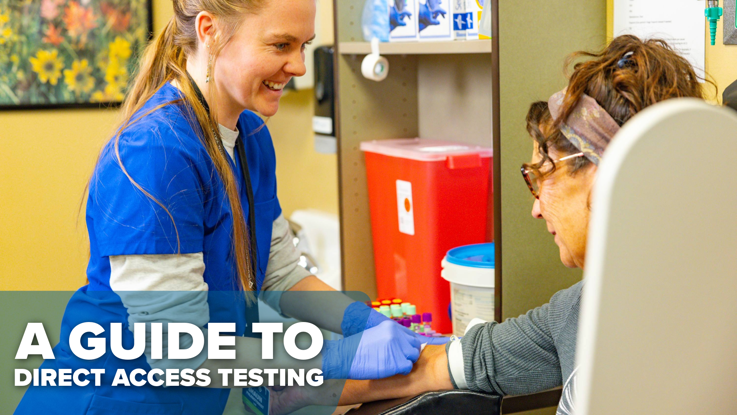
CBC orders can be placed by your licensed primary care provider or can be ordered as a self-pay procedure via Direct Access Testing (DAT). The lab is available 7 days a week (weekends included!) from 7:30 AM to 6:00 PM, no appointment needed.
Fun Fact!
Did you know that vampires exist (kind of)? Vampyre Disease, or porphyria, is a rare group of inherited blood disorders believed to be one of the bases for vampire myths. Porphyria affects the production of heme, which is a component of hemoglobin, a protein in our red blood cells. Common symptoms include sunlight sensitivity and the receding of gumlines, which might make one look as if they have fangs.